

Currently Empty: ر.ق 0,00


IELTS
How to Prepare for IELTS Exam in Qatar: Step-by-Step Guide
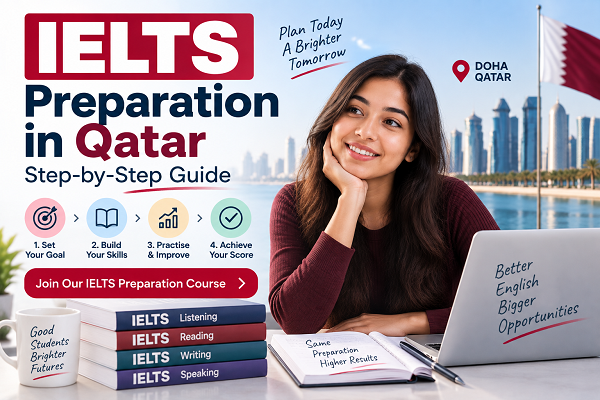
Preparing for the IELTS exam can be challenging if you do not have a clear study plan. Many candidates in Qatar spend weeks studying English but still struggle to reach the band score they need because they do not know how to prepare for the specific IELTS test format.
The right IELTS preparation in Qatar should combine English-language development, exam strategies, regular practice, timed tests, and professional feedback.
Whether you are preparing for university admission, employment, migration, or professional registration, this guide will show you how to prepare for IELTS step by step and how an IELTS preparation course can help you make faster progress.
What Is the IELTS Exam?
IELTS assesses your ability to communicate in English across four skills:
- Listening
- Reading
- Writing
- Speaking
Listening and Speaking are the same in IELTS Academic and General Training, while Reading and Writing differ between the two test types.
The overall IELTS band score is calculated from your four individual section scores and reported on a 0–9 band scale.
Before you start preparing, therefore, the first question is not “How can I improve my IELTS score?”
It is:
“Which IELTS test do I need, and what score do I need to achieve?”
Step 1: Choose the Right IELTS Test
IELTS offers different test types for different purposes.
IELTS Academic
IELTS Academic is generally designed for people who need to demonstrate English proficiency for higher education or professional purposes.
IELTS General Training
IELTS General Training is commonly used for migration and certain work, training, or study purposes.
The Reading and Writing sections differ between Academic and General Training, so choosing the correct test is essential before you begin your preparation.
If you are unsure which test you need, check the requirements of your university, employer, professional organisation, or immigration authority before booking.
Step 2: Find Out Your Target Band Score
Your preparation strategy should be based on your target score.
For example, preparing for Band 6 is different from preparing for Band 7.5 or 8.
Your target score may depend on:
- University admission requirements
- Employer requirements
- Professional registration
- Immigration requirements
- Scholarship requirements
You should also check whether you need a minimum score in each individual section.
Example
Suppose your target is:
| IELTS Skill | Target |
|---|---|
| Listening | 7.0 |
| Reading | 7.0 |
| Writing | 6.5 |
| Speaking | 7.0 |
| Overall | 7.0 |
This gives you a much clearer preparation goal than simply saying, “I want to improve my English.”
Step 3: Take a Diagnostic IELTS Test
Before starting an intensive preparation programme, take a realistic practice test.
This gives you a baseline.
For example, you may discover:
- Listening: 6.5
- Reading: 7.0
- Writing: 5.5
- Speaking: 6.0
In this situation, spending most of your time on Reading would not be the best strategy. Writing and Speaking would need greater attention.
A diagnostic test can help you identify:
- Your current band level
- Your strongest skills
- Your weakest skills
- Your most common mistakes
- Your time-management problems
- The gap between your current and target scores
Step 4: Understand the IELTS Exam Format
Knowing the English language is not enough. You also need to understand how IELTS works.
Listening
The Listening test contains 40 questions across four parts. You hear the recordings once, and different English accents may be used.
Practise:
- Following conversations
- Identifying specific information
- Recognising paraphrases
- Predicting answers
- Checking spelling
- Managing distractions
Step 5: Improve Your IELTS Reading Skills
IELTS Reading requires more than understanding English.
You need to find information quickly and distinguish between relevant and irrelevant information.
The Reading test contains 40 questions and lasts 60 minutes.
Practise:
- Skimming
- Scanning
- Identifying keywords
- Recognising paraphrasing
- Understanding headings
- Identifying writer opinions
- Managing time
A useful strategy
Do not automatically read every word of a passage slowly.
Instead:
- Read the question.
- Identify important keywords.
- Scan the passage.
- Locate the relevant section.
- Read that section carefully.
- Confirm your answer.
Step 6: Build Your IELTS Writing Skills
Writing is one of the areas where many IELTS candidates need professional feedback.
For IELTS Academic Writing, you complete two tasks in 60 minutes. Task 1 requires at least 150 words, while Task 2 requires at least 250 words. Task 2 carries twice the weight of Task 1 in the Writing score.
Your Writing performance is assessed through:
- Task response/achievement
- Coherence and cohesion
- Lexical resource
- Grammatical range and accuracy
To improve your Writing:
Practise:
- Planning essays
- Writing clear introductions
- Developing main ideas
- Using relevant examples
- Organising paragraphs
- Using appropriate vocabulary
- Checking grammar
- Completing tasks within the time limit
Do not simply memorise model essays.
Instead, learn how to generate, develop, and organise ideas.
Step 7: Develop Your IELTS Speaking Skills
IELTS Speaking is a face-to-face interview with an examiner and lasts approximately 11–14 minutes. It contains three parts.
The examiner evaluates:
- Fluency and coherence
- Lexical resource
- Grammatical range and accuracy
- Pronunciation
How to practise
Do not only practise vocabulary lists.
Speak regularly about:
- Your hometown
- Education
- Work
- Family
- Technology
- Travel
- Hobbies
- Environment
- Health
- Society
Record yourself answering IELTS-style questions and listen for:
- Long pauses
- Repeated words
- Grammar mistakes
- Unclear pronunciation
- Short or undeveloped answers
Step 8: Build an IELTS Vocabulary System
Vocabulary is important across all four skills.
However, effective IELTS vocabulary preparation is not about memorising thousands of difficult words.
Instead, focus on:
Topic Vocabulary
Build vocabulary around common IELTS themes:
- Education
- Technology
- Environment
- Health
- Employment
- Society
- Government
- Transport
- Globalisation
Collocations
Learn natural combinations such as:
- achieve a goal
- gain experience
- play a significant role
- address a problem
- improve access to education
- reduce environmental impact
Paraphrasing
IELTS frequently tests your ability to recognise different ways of expressing the same idea.
For example:
Question:
“Many people believe that technology has changed education.”
Paraphrase:
“Technology has transformed the way people learn and access educational resources.”
Step 9: Improve Your Grammar Through Practice
You do not need to use complicated grammar in every sentence.
Instead, aim for a combination of:
- Accurate simple sentences
- Complex sentences
- Conditional structures
- Relative clauses
- Passive structures
- Appropriate linking structures
Most importantly, identify your repeated errors.
For example, if you regularly make mistakes with:
- Articles
- Verb tenses
- Subject-verb agreement
- Prepositions
- Countable and uncountable nouns
then those areas should become part of your weekly study plan.
Step 10: Practise Under Real Time Conditions
One of the biggest differences between normal English practice and IELTS preparation is time pressure.
You may understand the questions perfectly but still lose marks because you cannot finish on time.
Include timed practice in your preparation.
Example Weekly Practice
| Day | Main Focus |
|---|---|
| Monday | Listening + Vocabulary |
| Tuesday | Reading + Grammar |
| Wednesday | Writing Task 2 |
| Thursday | Speaking + Vocabulary |
| Friday | Reading + Listening |
| Saturday | Full Writing Practice |
| Sunday | Mock Test + Error Review |
The exact schedule should depend on your current level and target score.
Step 11: Take Regular IELTS Mock Tests
Mock tests are an important part of effective IELTS preparation.
A full mock test allows you to practise:
- Exam timing
- Concentration
- Time management
- Question strategies
- Speaking under pressure
- Writing within the time limit
More importantly, mock tests help you measure progress.
For example:
Initial diagnostic: Overall 6.0
After four weeks: Overall 6.5
After eight weeks: Overall 7.0
This gives you evidence that your preparation strategy is working.
Step 12: Review Your Mistakes
One of the most overlooked parts of IELTS preparation is reviewing mistakes.
Do not simply complete a practice test, check the answers, and move on.
Create an IELTS Error Log.
| Mistake | Example | Why It Happened | Solution |
|---|---|---|---|
| Reading | Wrong heading | Misread main idea | Practise identifying paragraph purpose |
| Listening | Spelling error | Did not check answer | Review spelling after practice |
| Writing | Weak example | Idea not developed | Practise explanation + example |
| Speaking | Long pauses | Limited vocabulary | Practise topic vocabulary |
Your mistakes tell you what to study next.
How Long Does IELTS Preparation Take?
There is no single preparation period that works for every candidate.
Your ideal study period depends on:
- Current English level
- Target band score
- Previous IELTS experience
- Available study time
- Strengths and weaknesses
- Familiarity with IELTS question types
A candidate who needs to move from Band 6 to 7 may need a different plan from someone who is already close to their target.
A Practical Approach
4–6 weeks: Intensive preparation for candidates already near their target.
8–12 weeks: More structured preparation for candidates who need improvement across multiple skills.
3+ months: Better for candidates who need significant English-language development alongside IELTS skills.
The important point is to assess your level first rather than choosing a study period based on someone else’s experience.
Self-Study vs IELTS Preparation Course in Qatar
Many candidates ask whether they should study alone or join an IELTS preparation course.
Both approaches can work, but they offer different advantages.
| Self-Study | IELTS Preparation Course |
|---|---|
| Flexible schedule | Structured study plan |
| Lower direct cost | Professional instruction |
| Study at your own pace | Regular accountability |
| Good for independent learners | Teacher feedback |
| Difficult to assess Speaking | Speaking guidance |
| Difficult to evaluate Writing | Writing feedback |
| Requires strong self-discipline | Guided preparation |
If you are unsure about your level or struggling to improve despite practising, professional IELTS preparation can save time by identifying exactly what needs to change.
Why Choose IELTS Preparation in Qatar?
For candidates in Qatar, choosing a local IELTS preparation course can provide practical advantages.
You can benefit from:
- Face-to-face instruction
- Local class schedules
- Direct access to IELTS instructors
- Speaking practice
- Writing feedback
- Mock tests
- Structured preparation
- A learning environment focused on IELTS
For candidates preparing for university, work, or migration, having a clear preparation plan can make the process much more manageable.
How to Choose the Right IELTS Course in Qatar
Before enrolling in an IELTS course, consider these questions:
Does the course cover all four skills?
Your preparation should address Listening, Reading, Writing, and Speaking.
Do instructors provide individual feedback?
Feedback is especially valuable for Writing and Speaking.
Are mock tests included?
Regular mock tests help measure your progress.
Is the course suitable for your target band?
A candidate aiming for Band 6 may need a different approach from someone targeting Band 8.
Does the course follow a structured curriculum?
You should know what you are expected to learn and practise each week.
Your 8-Week IELTS Preparation Plan
If you are looking for a structured starting point, this eight-week plan can help.
Weeks 1–2: Assessment & Foundations
Focus on:
- Diagnostic test
- Exam format
- Grammar weaknesses
- Core vocabulary
- Reading and Listening strategies
Weeks 3–4: Skill Development
Focus on:
- Reading question types
- Listening strategies
- Writing structure
- Speaking fluency
- Topic vocabulary
Weeks 5–6: Intensive Practice
Complete:
- Timed Reading tests
- Timed Listening tests
- Writing Task 1 and Task 2
- Speaking practice
- Regular error analysis
Week 7: Mock Tests
Complete full IELTS simulations.
Identify your remaining weaknesses.
Week 8: Final Preparation
Focus on:
- Weak areas
- Time management
- Exam strategies
- Speaking confidence
- Writing accuracy
- Final mock test
Avoid trying to learn large amounts of new material immediately before your exam.
IELTS Preparation Checklist
Before your IELTS test date, make sure you can answer “yes” to the following:
- I know which IELTS test I need.
- I know my target band score.
- I have completed a diagnostic test.
- I understand the IELTS format.
- I have practised all four skills.
- I can complete Reading within the time limit.
- I can complete Writing within 60 minutes.
- I have practised IELTS Speaking with feedback.
- I have completed full mock tests.
- I have reviewed my recurring mistakes.
- I have a clear plan for test day.
Get Professional IELTS Preparation in Qatar with IFI Qatar
Preparing for IELTS on your own can work, but many candidates improve faster when they have a structured programme and professional feedback.
IFI Qatar’s IELTS Preparation Course can help you develop the skills, strategies, and confidence required for the exam.
A structured IELTS preparation programme can help you:
- Understand the IELTS test format
- Build skills across all four sections
- Practise authentic IELTS-style questions
- Improve Writing and Speaking performance
- Identify and correct recurring mistakes
- Develop effective exam strategies
- Prepare through realistic mock tests
Whether your target is Band 6, 7, 8, or higher, the right preparation should start with your current level and work systematically toward your target.
Ready to Start Your IELTS Preparation?
Don’t wait until your IELTS test date is approaching to discover your weaknesses.
Join an IELTS Preparation Course with IFI Qatar and build a structured plan toward your target band score.
[Start Your IELTS Preparation →]
Frequently Asked Questions About IELTS Preparation in Qatar
How should I start IELTS preparation in Qatar?
Start by identifying the IELTS test you need, determining your target band score, and taking a diagnostic test. Then create a study plan based on your current strengths and weaknesses.
How many hours a day should I study for IELTS?
The ideal number depends on your current level and target. Consistent, focused practice is generally more useful than occasional long study sessions.
How long does IELTS preparation take?
It depends on your current English level, target score, and study schedule. Candidates close to their target may need several weeks, while those who need broader language development may benefit from several months of preparation.
Should I take an IELTS preparation course?
A course can be particularly useful if you need structured guidance, Writing and Speaking feedback, regular practice, or help with exam strategies.
Is IELTS preparation different for Academic and General Training?
Yes. Listening and Speaking are the same, but Reading and Writing are different between Academic and General Training.
How can I improve my IELTS Writing score?
Practise regularly, learn how IELTS Writing is assessed, develop ideas clearly, improve grammar and vocabulary, and get detailed feedback on your writing. IELTS Writing is assessed using four criteria, including task response/achievement, coherence and cohesion, lexical resource, and grammatical range and accuracy.
How can I improve my IELTS Speaking score?
Practise speaking regularly and work on fluency, vocabulary, grammar, and pronunciation. These are the four criteria used to assess IELTS Speaking.
Should I take a mock test before IELTS?
Yes. A realistic mock test can help you understand your current performance, practise under time pressure, and identify areas that require further preparation.
Final Thoughts
Successful IELTS preparation in Qatar is not simply about studying English every day. It is about knowing your target, understanding the exam, identifying your weaknesses, practising strategically, and measuring your progress.
A strong preparation process should combine:
Assessment → Strategy → Practice → Feedback → Mock Tests → Improvement
If you are serious about achieving your target IELTS band score, starting with a structured preparation plan can make your study time more productive.
Start your IELTS preparation with IFI Qatar and take a focused step toward your target score.