

Currently Empty: ر.ق 0,00


Grammar
IELTS Grammar: Using That, Who & Which Like a Pro
Using That, Who & Which Like a Pro
Take a Listen!
Reading and Practice Time: 10 – 15 Minutes
Why This Matters for IELTS Writing Task 2
In IELTS Writing Task 2, grammar range and accuracy are key. One of the easiest ways to show complex sentence control is by using relative clauses — and these often start with that, who, or which. Used correctly, they help you join ideas smoothly, avoid repetition, and sound more academic and natural.
1. Understanding Relative Clauses
A relative clause adds extra information about a noun — without starting a new sentence.
It’s introduced by a relative pronoun such as who, which, or that.
| Relative Pronoun | Used For | Example |
| who | people | Students who study regularly perform better. |
| which | things | The policy which reduces waste is effective. |
| that | people and things (less formal, often used in IELTS essays) | The book that changed my opinion is about climate change. |
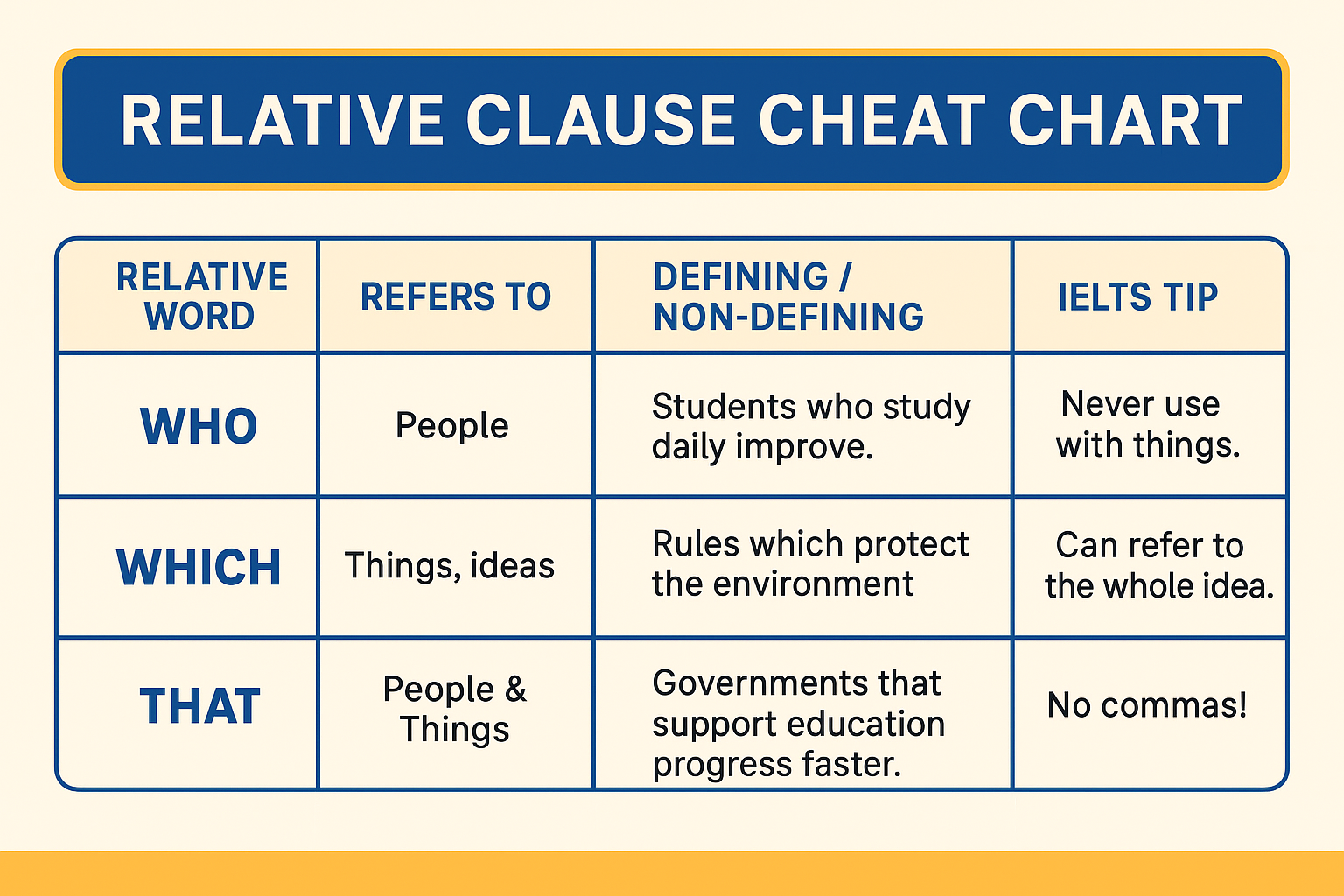
Summary Chart (Infographic Overview)
Here’s a table of everything we have covered so far:
2. How to Use Them Perfectly
A. WHO — for people
Used to describe someone or a group of people.
- People who read widely write better essays.
- Teachers who motivate their students create lasting impact.
- Anyone who wants a high band score must practice writing daily.
Tip: Avoid confusing “who” with “which.” “Who” = humans only!
B. WHICH — for things, ideas, or facts
- Education which focuses on creativity encourages innovation.
- Pollution which comes from factories affects urban life.
- The decision which was made yesterday caused public debate.
Pro Tip:
You can also use “which” to refer to the whole idea of the previous clause:
IELTS is a global exam, which means it requires universal English skills.
C. THAT — flexible and powerful!
It can replace who or which, especially in defining (essential) clauses.
- Students that work hard succeed.
- The program that helps learners improve vocabulary is popular.
- Governments that invest in education see better progress.
Important:
You cannot use commas with “that” clauses (they are defining).
✔️ Correct: The city that grows fast faces housing issues.
❌ Wrong: The city, that grows fast, faces housing issues.
3. Activities & Practice
Activity 1: Fill in the Gaps
Complete the sentences with who, which, or that.
- The teacher ____ inspired me most was very patient.
- The country ____ invests in education often develops faster.
- Students ____ do not plan their essays make more mistakes.
- The device ____ saves energy is now widely used.
- People ____ read academic articles tend to score higher in IELTS Writing.
(Answers: who, that, who, which, who)
Activity 2: Rewrite & Upgrade
Join the two simple sentences into one using who, which, or that.
- The book is interesting. It explains climate change clearly.
- The students were nervous. They took the IELTS test yesterday.
- The app is popular. It helps learners practice grammar.
Example answers:
- The book which explains climate change clearly is interesting.
- The students who took the IELTS test yesterday were nervous.
- The app that helps learners practice grammar is popular.
Activity 3: IELTS Context Practice
Write one sentence about education, technology, and environment, each using:
- one who-clause,
- one which-clause, and
- one that-clause.
Then check if your sentences are clear, formal, and grammatically correct.
4. Common IELTS Mistakes
| Mistake | Why it’s wrong | Correct form |
| People which study a lot… | “Which” ≠ people | People who study a lot… |
| The rule, that is strict, should change. | “That” ≠ non-defining (with commas) | The rule, which is strict, should change. |
| The car who runs fast… | “Who” ≠ things | The car which runs fast… |
5. Band 9 Example Sentences
- Governments that prioritize healthcare ensure a healthier society.
- Individuals who take responsibility for the environment make a difference.
- Education systems which promote creativity build future innovators.
See how each adds precision and fluency — a key feature of Band 9 grammar.
In conclusion
Mastering accurate grammar is essential for success in IELTS Writing, as it directly impacts both clarity and coherence — two key scoring criteria. Understanding how to use structures like relative clauses not only makes sentences more sophisticated but also helps ideas flow logically. At IFI’s IELTS preparation classes, students receive expert guidance and hands-on practice in using grammar effectively, ensuring they write with precision and confidence. This focused training empowers learners to produce essays that meet the expectations of examiners and achieve higher band scores.
Click here to take IFI’s Online English Placement Test and start your IELTS journey today!
More Practice:
Extra IELTS Grammar Exercise: Relative Clauses (that, who & which)
You May Also Like:
The Three Present Tenses
How to Use -ed & -ing Adjectives for IELTS Success
20 Verbs with Irregular Past Tense Forms