

Currently Empty: ر.ق 0,00


IELTS Writing Task 1 AC
IELTS Writing Task 1 Academic: The Differences Between Band 7, 8, and 9 (sample line graph)

IELTS Writing Task 1 Academic: The Differences Between Band 7, 8, and 9
Take a Listen!
Reading Time: 10 Minutes
Many IELTS students struggle to understand why their Writing Task 1 reports score lower than expected. Learning how different band levels are graded is one of the most effective ways to improve your IELTS writing score. Each band — from 7 to 9 — represents a clear difference in how well candidates describe data, organize ideas, and use academic vocabulary and grammar. By comparing real examples of IELTS writing task 1 band 7, band 8, and band 9 sample answers, you can easily see what makes a high-scoring report stand out.
Learning from Band Score Differences
Understanding what separates each band level helps you know exactly what to focus on in your own writing. For example, a Band 6 answer might include the right information but lack a clear overview or logical comparisons. A Band 9 response, on the other hand, uses advanced language, organizes ideas smoothly, and explains trends accurately. Seeing these differences in real samples makes IELTS Writing Task 1 much easier to master.
Focus on What Really Improves Your Score
Studying reports from different band levels teaches you to write with purpose. You don’t need to memorize templates or difficult words. Instead, focus on what examiners actually assess: clear task achievement, good organization, varied vocabulary, and correct grammar. Understanding these areas helps you move from a Band 6 to a Band 8 or even Band 9 — and also improves your overall English writing skills.
Band 9, 8, and 7 Sample Task 1 Sample Answers
In the following examples, pay close attention to the factors that influence each band score, including task achievement, cohesion and coherence, lexical resource, and grammatical range and accuracy. By carefully analyzing these IELTS writing task 1 sample answers along with the examiner’s evaluation, you’ll be better equipped to identify areas for improvement and develop strategies that will enhance your own IELTS Task 1 performance.
Band 9 Sample Answer
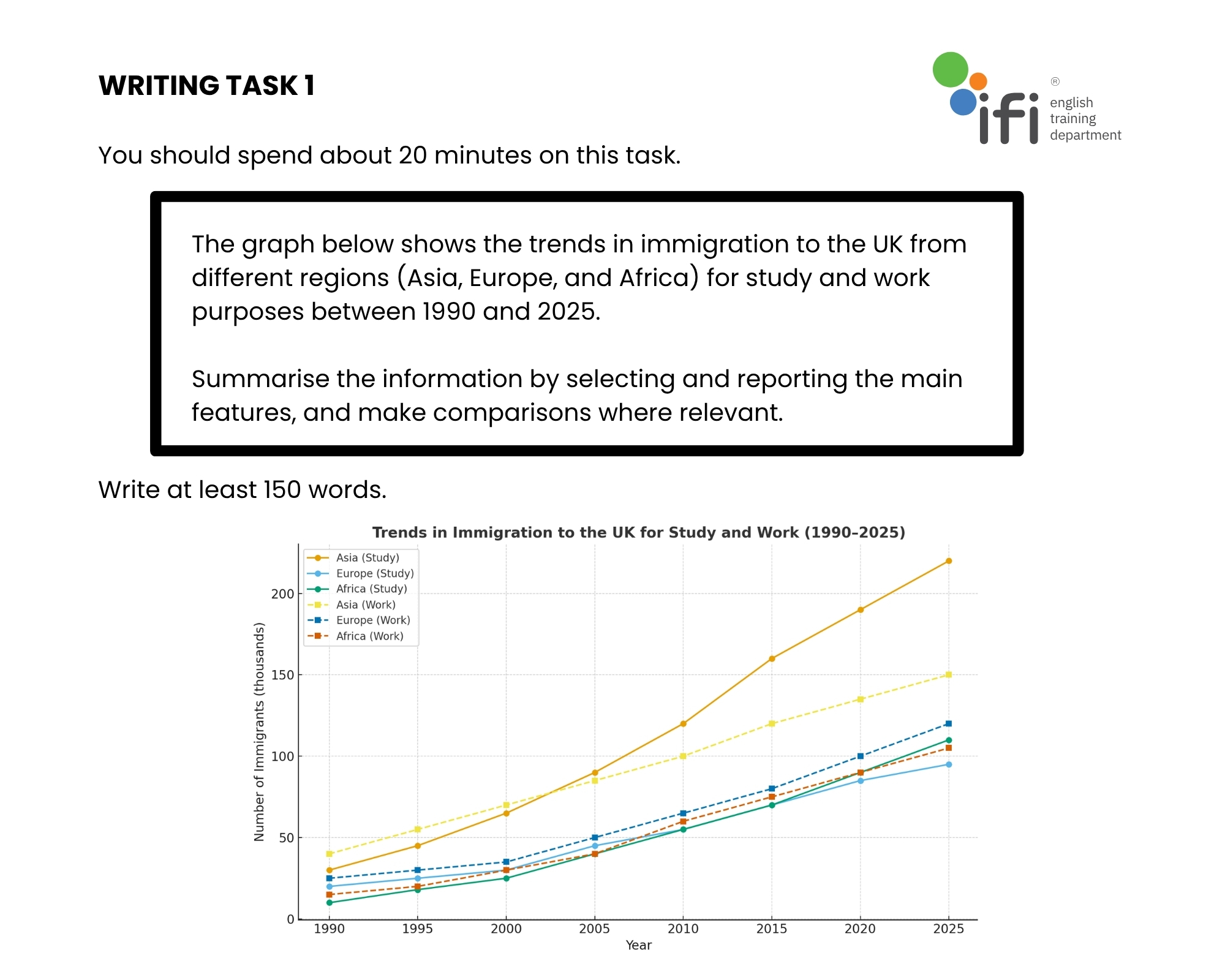
The line graph illustrates the trends in immigration to the United Kingdom for study and work purposes from three regions — Asia, Europe, and Africa — over the period from 1990 to 2025.
Overall, it is evident that immigration from all regions has increased steadily throughout the period, with the number of people coming for study rising more sharply than those arriving for work. Asian immigrants consistently made up the largest group in both categories, while figures for Africa, although lower at first, showed the fastest growth in recent years.
In 1990, around 30,000 Asians migrated to the UK for study, compared to only 10,000 Africans and 20,000 Europeans. By 2025, the number of Asian students is expected to reach about 220,000, more than double that of Europe (95,000) and Africa (110,000). Similarly, immigration for work followed a rising pattern, with figures for Asia climbing from 40,000 in 1990 to 150,000 in 2025. Europe and Africa also saw gradual increases, reaching approximately 120,000 and 105,000, respectively, by the end of the period.
In summary, while the UK has experienced growing immigration for both study and work since 1990, the increase has been most pronounced among people from Asia, followed by steady but slower growth from Europe and Africa.
(206 words)
Band 9 Sample Answer – Evaluation
Task Achievement (9.0)
- Fully answers the question with a clear overview and all key trends.
- Provides accurate data comparisons and highlights patterns effectively.
- No irrelevant details or repetition.
Coherence and Cohesion (9.0)
- Logical flow from introduction → overview → details → summary.
- Cohesive devices (“Overall, it is evident…”, “Similarly…”, “In summary…”) are used naturally and precisely.
- Paragraphing is clear and purposeful.
Lexical Resource (9.0)
- Wide range of precise and academic vocabulary: “consistently made up the largest group,” “rising pattern,” “most pronounced among…”
- No awkward phrasing; excellent control of collocations and formality.
Grammatical Range and Accuracy (9.0)
- Complex sentences are varied and error-free.
- Excellent use of tenses and comparisons.
Estimated Band: 9.0
Comment: This is a model answer. It’s concise, well-organized, and uses a sophisticated tone typical of a top IELTS performer.
Band 7–8 Sample Answer
The line graph shows changes in the number of people coming to the UK from Asia, Europe, and Africa for study and work between 1990 and 2025.
Overall, immigration to the UK increased in all regions over the period. More people came to study than to work, and Asian immigrants made up the largest group in both categories.
In 1990, about 30,000 students from Asia went to the UK, while the numbers from Europe and Africa were much lower, at around 20,000 and 10,000, respectively. By 2025, the figure for Asian students is expected to rise sharply to about 220,000, compared with 95,000 from Europe and 110,000 from Africa.
A similar upward trend can be seen in immigration for work. Asian workers rose from 40,000 in 1990 to 150,000 in 2025, while European and African workers increased more gradually to about 120,000 and 105,000.
In summary, the UK attracted more immigrants for both study and work, especially from Asia, which showed the highest and fastest growth over time.
(168 words)
Band 7–8 Sample Answer – Evaluation
Task Achievement (7.5)
- Covers all main trends and comparisons, though some analysis is more basic.
- The overview is clear but not as detailed or insightful as the Band 9 version.
Coherence and Cohesion (8.0)
- Logical structure with clear progression.
- Linking words are used correctly but sometimes repetitively (“while,” “by 2025,” “a similar upward trend”).
Lexical Resource (7.5)
- Vocabulary is appropriate and accurate but simpler (“shows changes,” “rose from,” “increased more gradually”).
- Lacks the range and precision of higher bands.
Grammatical Range and Accuracy (7.5)
- Mostly complex and correct sentences, with some basic structures.
- Occasional minor simplification but no real grammar errors.
Estimated Band: 7.5–8.0
Comment: This response is clear, accurate, and well-organized. It would likely score in the upper Band 7 range, possibly Band 8 if language and comparisons were slightly more advanced.
In Conclusion
Studying IELTS writing Task 1 sample answers and learning to spot what makes them great helps IELTS test-takers boost their scores. IFI’s IELTS prep courses make this easy by breaking down top-scoring answers and teaching students how to identify areas for improvement. With IFI’s fun and focused approach, getting your dream score is just a few secrets away!
Find out more about IFI’s IELTS writing preparation courses!
We Strongly Recommend:
IELTS Academic Writing Task 1 – How to reach a band 7
You May Also Like:
How to Describe Diagrams in IELTS Task 1 Academic + Sample Answer 4
IELTS Writing Task 1 – Sample Answer 3 (Bar Charts)
5 Key Structures for Comparing Data in Task 1 Academic