

Currently Empty: ر.ق 0,00


IELTS
IELTS Writing Task 2 – Sample Answer 1 (Opinion Essay)

IELTS Writing Task 2 – Sample Answer 1 (Opinion Essay)
Take a Listen!
Reading Time: 14 – 15 Minutes
If you are an IELTS candidate, reading sample responses to Writing Task 2 topics is highly beneficial for you. Here is how you would benefit:
- Understanding the importance of a clear introduction, well-developed body paragraphs, and a concise conclusion
- Inspiring you to develop your ideas and arguments
- Exposing you to a range of vocabulary, idioms, and grammatical structures that you can incorporate into your writing
- Recognizing and avoiding common errors related to coherence, cohesion, grammar, and task achievement
- Helping you become comfortable with the different demands and structures associated with each topic type (advantage/disadvantage, argument, etc.)
- Gaining confidence in your abilities as you become more familiar with the expectations and requirements of IELTS Writing Task 2.
The bottom line is that reading and analyzing sample responses is an invaluable part of IELTS preparation. It can significantly improve candidates’ writing skills and overall performance in the exam. You can start with the sample below:
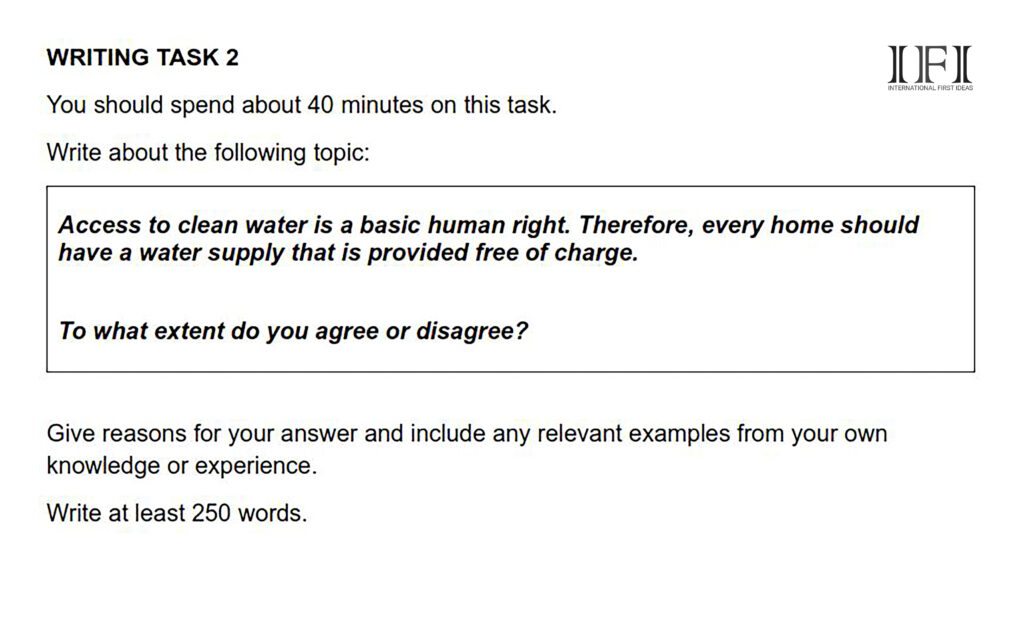
Sample answer:
Access to clean water is indeed a fundamental human right, essential for survival and maintaining an acceptable quality of life. In this light, the idea of supplying every home with free water holds significant merit. However, such a proposal is not without its complexities. In this essay, I shall discuss the potential benefits and drawbacks of providing water free of charge to all households.
On the one hand, the provision of free water can have numerous benefits. Primarily, it ensures that everyone, regardless of socio-economic status, can access this vital resource. This, in turn, can contribute to reducing the health disparities often associated with contaminated or scarce water supplies. Additionally, making water accessible to all could promote improved hygiene and sanitation practices, leading to healthier communities and, ultimately, reduced burdens on public health systems.
Moreover, implementing such a policy might instill a sense of societal equity, as it provides the same essential resources to all citizens, regardless of their financial capabilities. This can contribute to increased social cohesion and trust in governmental institutions.
However, on the other hand, several potential drawbacks must be considered. Firstly, the implementation of free water supplies would necessitate significant infrastructural development, maintenance, and monitoring, all of which incur substantial costs. It might be challenging to secure adequate funding without imposing additional taxes or diverting resources from other critical areas, such as education or healthcare.
Secondly, the provision of free water might inadvertently encourage wasteful practices, as people may be less mindful of their consumption when there is no associated cost. This not only has environmental implications but could also strain the very water systems intended to serve everyone.
In conclusion, while the idea of providing every home with free water access is noble and undeniably beneficial in certain respects, it also presents significant challenges and potential negative consequences. Rather than implementing such a radical policy, a more balanced approach might involve offering affordable, tiered pricing based on water usage and user income, thereby providing access while still promoting conservation. Furthermore, investments in education and public awareness campaigns about water usage and conservation could contribute to a more sustainable, equitable water future for all.
Useful phrases:
Here is a list of phrases from the sample answer that IELTS candidates might find useful, along with their meanings:
- Access to clean water is a fundamental human right: It means that having clean water is a basic and essential entitlement for every human being.
- Essential for survival: Something that is crucial and necessary for sustaining life.
- Maintaining an acceptable quality of life: To have a decent or satisfactory standard of living.
- The idea holds merit: This means that the idea is valuable and worth considering.
- Socio-economic status: A person’s or group’s position in society based on income, education, and occupation.
- Health disparities: Differences in health outcomes among different groups of people.
- Contaminated or scarce water supplies: Water sources that are either polluted or limited in quantity.
- Promote improved hygiene and sanitation practices: Encourage better habits related to cleanliness and health to maintain a clean environment.
- Reduced burdens on public health systems: Decrease the strain or pressure on healthcare services provided by the government.
- Societal equity: Fairness and justice in society regarding the distribution of resources and opportunities.
- Social cohesion: The strength of shared values and behaviors in a community.
- Infrastructural development: Building or improving the basic structures and facilities needed for a society to function.
- Diverting resources: Shifting funds or other resources from one area to another.
- Inadvertently encourage wasteful practices: Accidentally promote behaviors that lead to excessive use of resources.
- Implementing a radical policy: Putting into action a significant and far-reaching plan or rule.
- Affordable, tiered pricing: Offering prices at different levels depending on people’s income or needs.
- Public awareness campaigns: Initiatives designed to spread information and educate people about a specific issue.
- Promoting conservation: Encouraging the preservation and protection of natural resources.
Learning these phrases and their meanings can help IELTS candidates enrich their vocabulary and better express their ideas on various topics.
Positive features of the sample answer
This essay is a good sample and would likely receive a high score for several reasons:
- Clear Position: The writer clearly states their opinion on the topic, discussing both the benefits and drawbacks of providing free water to all households. This demonstrates the ability to analyze a complex issue.
- Well-Structured: The essay is well-organized and follows a logical flow of ideas. It starts with an introduction, presents arguments in separate paragraphs, and ends with a conclusion that summarizes the writer’s opinion.
- Cohesive Devices: The writer uses appropriate linking words and phrases (e.g., “however,” “on the one hand,” “on the other hand,” “moreover,” “secondly”) to create a smooth connection between sentences and paragraphs.
- Vocabulary: The writer uses a range of vocabulary relevant to the topic and showcases their ability to express ideas with precision and clarity.
- Grammatical Range and Accuracy: The essay displays a variety of grammatical structures, and they are used accurately and appropriately.
- Task Achievement: The writer fully addresses all parts of the task by discussing both sides of the argument and providing a clear opinion in the conclusion.
Considering these factors, the essay demonstrates the candidate’s ability to write a well-organized, well-supported, and clear response to the given prompt, which are key criterion for achieving a high score on the IELTS writing test.